Walking Without Headphones: A Simple Mindful Walk Guide
Leave the headphones behind, choose a short familiar route, and turn an ordinary walk into a simple exercise in attention.
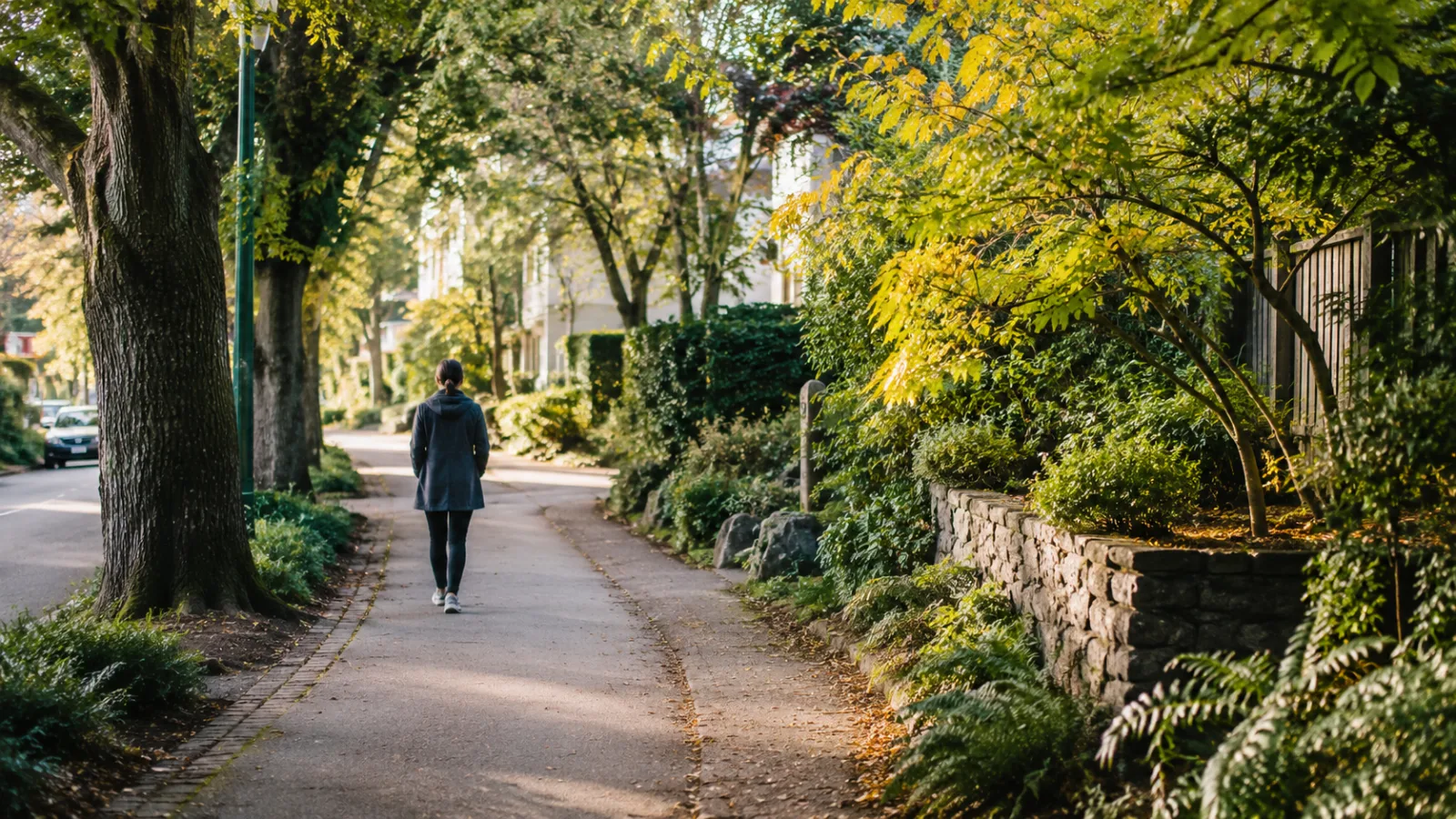
Walking is one of the easiest activities to overload. You leave the house, put on a podcast, reply to a message at a crossing, check the route, change the song, and arrive without remembering much of the journey. Your body went for a walk. Your attention stayed somewhere else.
A mindful walk is not a more impressive kind of walking. It is simply a walk where you notice that you are walking.
You do not need a forest, a meditation app, special breathing instructions, or an hour of free time. You need a short route, no audio in your ears, and one simple thing to pay attention to.
This guide will show you how to choose an easy loop, use sensory prompts without turning the walk into homework, and finish with a short observation log. It also includes versions for lunch breaks, low-energy days, city streets, parks, and bad weather.
What mindful walking actually means
Mindful walking is often described as meditation in motion. That can make it sound formal, but the basic practice is straightforward: you bring your attention back to the physical experience of moving through a place.
You notice your steps, breathing, surroundings, and the small details that normally disappear behind audio or thought. When your mind wanders, you return to something you can see, hear, or feel.
The aim is not to stop thinking. You will still remember work, replay conversations, plan dinner, and invent arguments for situations that are unlikely to occur.
The practice is noticing when your attention has left the walk and gently returning it. Walking without headphones helps because it removes one layer of input. It gives you access to the sounds of the route, including birds, traffic, wind, footsteps, conversations, construction, and whatever strange noise your neighbour’s gate has started making.
Research on short walks suggests that even brief bouts of walking can support mood and attention. Studies of mindful walking have also reported reductions in psychological stress and improvements in quality of life, although the results depend on the people, setting, and type of programme studied.
A mindful walk is not medical treatment. It is a simple way to move, reduce input, and practise being present for a small part of your day.
Start with a short loop
The easiest route is not the most beautiful one. It is the one you can begin without negotiation.
Choose a loop that takes between 10 and 20 minutes. It might go around your block, through two nearby streets, around a local green space, or to one fixed point and back.
A loop works well because the route has a natural ending. You do not need to decide how far to continue once you are outside, and you are less likely to turn a short walk into an accidental expedition.
For your first attempt, choose somewhere familiar. Knowing the route means you can spend less attention on navigation and more on what is happening around you.
Safety still comes first. Use well-lit routes, stay alert around traffic, and keep your phone available when you need it for directions, emergencies, or accessibility. Walking without headphones should improve awareness, not create a new rule that makes the walk less safe.
For a ready-made offline activity matched to your time and energy, you can also pick a Done IRL mission before you leave.
Give the walk one purpose
“Be present” is a vague instruction. Your attention usually responds better when it has a small, concrete job.
Choose one prompt before you start. Do not try to complete every prompt on the same walk.
You might look for:
- Three details you have never noticed
- Five different textures
- One repeated colour
- The quietest point on the route
- Signs that the weather or season is changing
- Something repaired, adapted, or reused
- The oldest-looking object you pass
- One place where nature is growing through the built environment
The purpose is not to win a scavenger hunt. The prompt gives your attention somewhere to return when it drifts.
A familiar route can feel completely different when you stop treating it as empty space between destinations.
Use the senses in sequence
A simple sensory sequence can help when your thoughts are especially loud. Spend a few minutes with each sense rather than trying to notice everything at once.
Begin with what you can feel
Notice how your feet meet the ground. Pay attention to pressure, pace, balance, and the movement of your legs.
Feel the temperature on your face and hands. Notice whether the air is dry, humid, still, or moving.
You do not need to change your walking style. The goal is to notice the movement that was already happening.
Move to what you can hear
Without headphones, the route has its own soundtrack. Notice the closest sound, then the furthest sound you can identify. Separate continuous sounds, such as traffic or wind, from brief sounds, such as a door closing or a bird calling.
Avoid labelling sounds as good or annoying for a moment. Hear them as evidence of where you are.
Look at shape, colour, and distance
Instead of scanning for useful information, let your eyes stay with ordinary details. Notice the line of a roof, light on a wall, movement in a curtain, uneven paving, reflections in windows, or objects placed behind balconies.
Look nearby, then further away. This change in visual distance can help you stop staring at the same narrow range used for screens.
Notice smell without forcing it
Smell is less reliable on some routes, but it often creates strong location memories. You may notice rain on pavement, trees, food from a kitchen, laundry, soil, exhaust, or cold air. If nothing stands out, move on. Mindful walking is not a sensory performance review.
Let your thoughts come along
A common mistake is treating a mindful walk as a test of whether you can stop thinking. You cannot fail because your mind wandered. Minds wander.
The useful part is the return. When you notice that you have spent several minutes mentally rewriting an e-mail, choose one physical anchor. Feel three steps, notice one sound, or find one object in your selected colour.
Then continue walking. You may have to return 20 times during one short loop. That is not evidence that the walk did not work. Returning is the practice.
A 15-minute mindful walk you can try today
Here is a simple version that requires no preparation beyond choosing a safe route. For the first two minutes, walk at your normal pace and let yourself settle. Do not force attention anywhere yet.
For the next three minutes, focus on physical sensations: feet, legs, temperature, and breathing. Then spend three minutes listening. Notice near sounds, distant sounds, and the gaps between them.
For the next five minutes, use one visual prompt. Look for an unfamiliar detail, repeated colour, or sign of seasonal change.
During the final two minutes, stop searching and walk normally. Notice whether the route feels different from when you started.
The timings are optional. They simply prevent the walk from becoming another open-ended activity you postpone until you have more time.
Variation one: The lunch-break reset
A lunch-break walk should be easy enough to complete without turning the rest of the day into a scheduling incident. Choose a loop that takes 10 to 15 minutes and begins directly outside your home or workplace. Leave the headphones behind, even when you normally use the walk to catch up on a podcast.
Use one transition prompt: What changes as I move away from work? Notice when the soundscape changes, when your shoulders drop, when the buildings become quieter, or when your pace becomes more natural. On the way back, identify one thing you want to carry into the afternoon, such as a slower breath, a clearer priority, or simply the memory that the outside world still exists.
A short outdoor walk can create a stronger boundary around the middle of the day. Research has found that brief outdoor walking may improve aspects of cognitive performance more than a comparable indoor walk, although one walk will not repair an unreasonable workload.
Variation two: The low-energy walk
On a low-energy day, reduce the route before cancelling the activity. Walk to the end of the street and back. Circle the building once. Spend five minutes moving slowly around a courtyard, garden, or covered area.
Your prompt is: What feels easiest to notice? Do not demand a complete sensory exercise. Choose one thing, such as the air on your skin or the rhythm of your steps.
Keep the pace comfortable and stop before the walk becomes draining. The purpose is to change position, receive a little daylight or fresh air when available, and create a small interruption in the day.
A five-minute walk still counts. The walk is not invalid because it would fail to impress a fitness tracker.
Variation three: Mindful walking on city streets
City walking is sometimes treated as the inferior version of walking in nature. It does not have to be.
Urban routes contain texture, movement, sound, repair, architecture, reflections, lettering, improvised solutions, and evidence of thousands of separate lives. Choose a route with safe crossings and enough visual interest that you are not simply moving beside heavy traffic. Your prompt might be to notice balconies, old doorways, street trees, small independent shops, unusual shadows, or signs that people have altered a shared space.
Keep part of your attention on safety. Mindful walking in a city includes hearing approaching bicycles, watching crossings, and noticing other pedestrians.
You are not trying to escape the city while remaining inside it. You are practising seeing it as a place rather than an obstacle between appointments.
Variation four: A park observation walk
In a park, avoid trying to absorb all of nature at once. Choose one narrow theme.
You might follow movement: branches, insects, dogs, clouds, water, or people crossing a field. You could focus on edges: where grass meets a path, where light meets shade, or where a planted area becomes less controlled.
Walk more slowly than usual for part of the route. Stop once, but only when you find a place where standing still does not block anyone.
Notice what becomes visible after 30 seconds. Often, the first impression is broad, while the second contains movement, sound, and smaller details.
Nature-based walking studies suggest benefits for mood, stress, and rumination, but you do not need to turn the park into treatment. It can simply be a place where your attention has more room.
Variation five: Bad-weather mindful walking
Bad weather does not always make walking impossible. It changes the sensory material.
When conditions are safe, dress properly and shorten the route. Choose covered streets, a sheltered path, or a loop close to home.
Your prompt is: What does the weather change? Notice reflections on the ground, the sound of rain on different surfaces, the direction people turn their bodies against wind, the smell of wet soil, or the way familiar colours look under grey light.
Avoid romanticising unsafe conditions. Ice, extreme heat, storms, poor visibility, and flooding are reasons to stay inside.
For an indoor version, walk slowly through your building, a covered public space, or even from room to room at home. Pay attention to changes in temperature, light, floor texture, and sound.
Mindful walking depends more on attention than scenery.
Finish with a one-minute observation log
A mindful walk can disappear quickly unless you leave a small trace of it. When you return, write three short lines:
I noticed: one specific detail.
I felt: one physical or emotional change.
Next time: one thing you want to look for or change.
For example:
I noticed tiny plants growing between the stones behind the supermarket.
I felt less rushed by the time I reached home.
Next time I will take the quieter street.
Use paper or your phone notes. The log is not a diary commitment. It is a small record that helps separate this walk from every other time you covered the same route.
You can also take one photograph at the end, but only when the image supports the observation. The goal is to notice first and document second.
What are the benefits of walking without headphones?
Walking without headphones does not create a completely different form of exercise. The physical movement is still walking.
The difference is attention. Without continuous audio, you may become more aware of your surroundings, body, pace, and safety. The walk can also provide a rare period without new information entering your mind.
Short walks have been associated with improvements in mood and some aspects of attention. Mindful walking programmes have shown promising effects on stress and quality of life in certain groups, while nature-based walking research suggests possible benefits for mood and rumination.
These findings do not mean every quiet walk will feel peaceful. Some walks will be noisy, distracted, boring, or emotionally uncomfortable.
The benefit may be simpler: for 15 minutes, you were in the place where your body already was.
Mindful walking is not about walking perfectly
You do not need ideal posture, empty thoughts, a scenic route, or complete silence. You can walk slowly or at your usual pace. You can feel calm, irritated, tired, or distracted. You can notice traffic instead of birds and concrete instead of trees.
The practice is not creating a perfect walk. It is paying attention to the real one.
When your mind leaves, return to your feet, one sound, or one visible detail. When the loop ends, write down what stayed with you.
That is enough.
Frequently asked questions
What is mindful walking?
Mindful walking is the practice of paying deliberate attention while walking. You notice physical sensations, sounds, sights, and your surroundings, then return to those details when your mind wanders.
It can be practised on an ordinary short route and does not require formal meditation experience.
Is walking without headphones better?
It depends on the purpose of the walk. Music and podcasts can make walking enjoyable, while walking without headphones may improve awareness of your surroundings and create a break from continuous input.
You do not need to choose one approach permanently. Try one quiet walk and compare the experience.
Is mindful walking the same as walking meditation?
The terms often overlap. Formal walking meditation may use a slower pace, a defined path, and detailed attention to each part of a step.
A mindful walk can be less formal and fit into daily life, such as a lunch break or walk around the block.
How long should a mindful walk be?
Start with 10 to 20 minutes. A five-minute walk is also useful when energy or time is limited.
A short route you actually complete is better than an ambitious route you keep postponing.
What should I notice on a mindful walk?
Choose one prompt, such as sounds, textures, repeated colours, physical sensations, seasonal changes, or unfamiliar details. Using one prompt keeps the activity simple and gives your attention a clear place to return.
Can I use my phone during a mindful walk?
Keep it available for safety, directions, or accessibility. Avoid checking it automatically during pauses.
You can use it at the end to record a short observation or take one deliberate photograph.
Take the familiar route differently
You do not need a new destination. Choose a short loop you already know. Leave the headphones at home. Give your attention one job and let the route show you something you have missed.
Notice three details. Feel your feet meet the ground. Listen long enough to separate one sound from another.
When you return, write down one thing that stayed with you. For another simple activity that helps you step away from the screen and into the physical world, try the Done IRL mission picker.
The walk does not need to be long. You only need to be there for it.
Read more
- Mindful Walking in Psychologically Distressed Individuals: A Randomized Controlled Trial
- Experimental Effects of Brief, Single Bouts of Walking and Meditation on Mood Profile in Young Adults
- The Effects of a Guided Mindful Walk on Mental Health in a Clinical Setting
- Exercising Is Good for the Brain but Exercising Outside Is Potentially Better
